
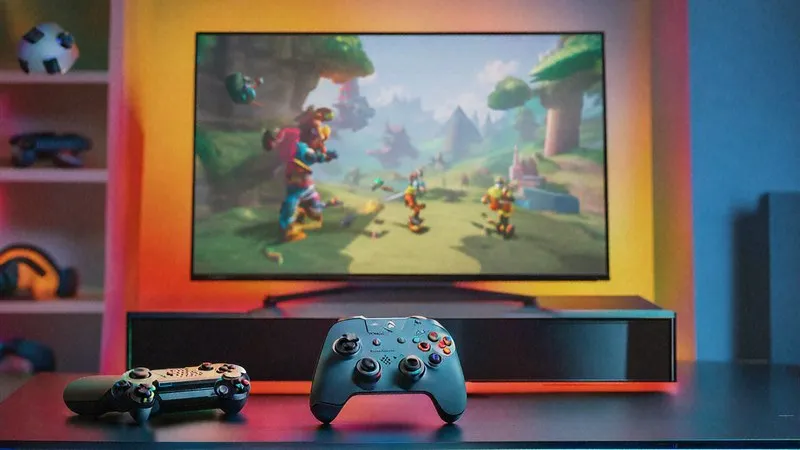
I was eleven years old, sitting cross-legged on the cold floor of my cousin's house in Pune, and I was playing Super Mario World on a Super Nintendo that he had somehow acquired from a relative in Dubai. I did not know the word "import" yet. I did not understand customs duty. All I knew was that this grey box with its purple buttons was the most magical thing I had ever touched, and that the fat plumber on the screen who kept dying in lava pits was making me happier than anything on Cartoon Network ever had.
That SNES was not mine. It was never going to be mine. My parents would not have known where to buy one even if they had wanted to. There was no Nintendo store, no official distributor, no shelf in any electronics shop in our neighbourhood that stocked anything with that red logo. Nintendo, for all practical purposes, did not exist in India. Not officially. Not for kids like me.
That was the mid-2000s. It is now 2026, and I am a grown man with a job and a bank account and a very real desire to hand over money to Nintendo for their newest console. The Switch 2 is coming. And for the first time in my life, there is a genuine possibility — not a certainty, but a possibility — that I might be able to walk into a store in India and buy a Nintendo console the way people in Tokyo or New York do. No begging NRI relatives. No shady import websites. No prayer circle over customs clearance.
But this is Nintendo we are talking about. And this is India. So forgive me if my excitement comes with a thick layer of scepticism.
A Brief, Painful History of Nintendo in India
To understand why the Switch 2 India launch matters, you need to understand just how badly Nintendo has handled this market for decades. Or rather, how completely they have ignored it.
The original Nintendo Entertainment System never came to India. The Super Nintendo never came to India. The N64, the GameCube, the Wii, the Wii U — none of them had official Indian distribution. While Sony set up shop with the PlayStation brand through official channels, while Microsoft brought the Xbox in through Redington, Nintendo simply pretended that the second most populous country on Earth did not exist.
The Nintendo DS and 3DS had a brief flirtation with the Indian market. A company called Milestone Interactive distributed some Nintendo handhelds in the early 2010s, but the effort was half-hearted at best. Stock was limited. Marketing was nonexistent. Pricing was bizarre. The initiative quietly died, and nobody at Nintendo's Kyoto headquarters seemed to lose any sleep over it.
When the original Nintendo Switch launched in March 2017, it was a global phenomenon. It sold 146 million units worldwide. It revived Nintendo's home console business. Breath of the Wild became one of the most celebrated games ever made. And through all of this — all seven years of the Switch's dominant run — India was not on the official launch list. Not at launch. Not a year later. Not ever.
Indian gamers who wanted a Switch had to get creative. The most common route was importing from Dubai or Singapore, where the console was readily available and the flight connections were convenient. Amazon Global shipping was another option, though you were rolling the dice on customs. Some people ordered through friends and family abroad. A cottage industry of grey market sellers popped up on Instagram and OLX, charging premiums of Rs 5,000 to Rs 10,000 over the international retail price.
I bought my Switch in 2019 from a seller in Nehru Place, Delhi's famous electronics market. He had imported a batch from Hong Kong. I paid Rs 28,000 for a console that retailed for $299 (roughly Rs 21,000 at the time). I did not have a warranty. I did not have a local repair option. When my left Joy-Con developed the infamous drift issue two years later, I had to ship it to a friend in Singapore who knew someone who knew someone at a repair shop. This is not how buying a gaming console should work.
Switch 2: Is India Finally on the Map?
Here is what we know, what is strongly rumoured, and what is pure speculation. I will try to be clear about which is which.
What we know: Nintendo officially unveiled the Switch 2 in January 2025 with a brief trailer, followed by a Nintendo Direct in April that showed off hardware details and launch titles. The console launched in major markets — North America, Europe, Japan, Australia, South Korea — in June 2025. As of early 2026, it has sold an estimated 22 million units globally.
What is strongly rumoured: Multiple credible sources, including Nikkei Asia and Bloomberg, have reported that Nintendo has been in discussions with Indian distributors since mid-2025. The most frequently mentioned partner is Redington India, which already distributes Apple products and has handled Xbox distribution in the past. According to a report from IGN India, Nintendo registered a new business entity in India in late 2025, which is typically a precursor to official market entry.
What is still speculation: The exact launch date for India. Some reports say Q2 2026, others say it could slip to the festive season around Diwali. The pricing is also unconfirmed, though there are enough data points to make educated guesses, which I will get to shortly.
The strongest signal that Nintendo is serious about India this time is the hiring activity. LinkedIn job postings from late 2025 showed Nintendo looking for a "Market Development Manager — India" and a "Distribution and Retail Partnerships Lead" based in Mumbai. You do not hire for those roles if you are planning to ignore a market.
But I have been burned before. We all have. Until I see a Switch 2 box with an Indian MRP sticker on it, sitting on a shelf at Croma or Reliance Digital, I am not popping any champagne.
The Price Problem: GST, Import Duty, and the Rs 40,000 Question
Let us talk about the number that will make or break the Switch 2 in India: the price.
The Nintendo Switch 2 retails for $449.99 in the United States. At the current exchange rate of roughly Rs 85 to the dollar, that translates to approximately Rs 38,250. But that is a meaningless number in the Indian context, because it ignores the tax and duty structure that inflates the price of every imported electronic device sold in this country.
Gaming consoles in India attract a Goods and Services Tax of 28%, the highest GST slab. On top of that, there are Basic Customs Duty charges that vary depending on how the product is classified and whether any components are assembled locally. For a fully imported gaming console, the total tax incidence can push the final price 40-50% above the base international price.
Here is what a rough pricing calculation looks like:
| Component | Amount (Estimated) |
|---|---|
| US retail price (converted) | Rs 38,250 |
| Basic Customs Duty (~20%) | Rs 7,650 |
| GST at 28% (on CIF + BCD value) | Rs 12,852 |
| Distributor margin and logistics | Rs 3,000 - 5,000 |
| Estimated India MRP | Rs 55,000 - 60,000 |
That is a painful number. For context, the PlayStation 5 Slim (disc edition) currently sells for around Rs 49,990 in India, and the Xbox Series X sits at roughly Rs 49,990 as well. Both of those consoles are significantly more powerful than the Switch 2, at least in terms of raw processing muscle. If the Switch 2 launches at Rs 55,000 or above, Nintendo is going to have a very tough time convincing Indian buyers that a hybrid handheld console is worth more than a PS5.
There is one scenario that could change this calculation: local assembly. If Nintendo partners with an Indian contract manufacturer — the way Samsung, Apple, and Xiaomi have done for smartphones — it could potentially reduce the customs duty burden and bring the price down to the Rs 44,990 to Rs 49,990 range. That would be competitive. That would make sense. But setting up a local assembly operation takes time, investment, and commitment to a market. Given Nintendo's historical reluctance to invest in India, I am not holding my breath.
The grey market will also serve as a price anchor. Right now, you can buy an imported Switch 2 from sellers in Nehru Place or Gaffar Market for around Rs 48,000 to Rs 52,000, with no warranty but immediate availability. If the official price is significantly higher than what importers charge, Nintendo will struggle. Indian consumers are extraordinarily price-sensitive, and the grey market ecosystem here is deeply entrenched.
Hardware: What the NVIDIA T239 and 8-Inch Screen Actually Mean
Let us move past the business side and talk about the machine itself, because the Switch 2 is, by any measure, a significant upgrade over its predecessor.
The heart of the Switch 2 is the NVIDIA T239 processor, a custom chip based on NVIDIA's Ampere architecture. For those who are not familiar with GPU architectures, Ampere is the same generation that powered the RTX 3000 series of desktop graphics cards — the ones that were impossible to buy during the crypto mining craze. Obviously, the T239 is a mobile-optimized, power-efficient version of that architecture, but the DNA is the same.
In practical terms, this means the Switch 2 is roughly four to five times more powerful than the original Switch in GPU performance. The original Switch used an NVIDIA Tegra X1 chip from 2015, which was already outdated when the console launched in 2017. The T239 brings the Switch 2 closer to Xbox Series S territory in handheld mode, and it supports DLSS (Deep Learning Super Sampling), which is NVIDIA's AI-powered upscaling technology. DLSS is a big deal because it allows the console to render games at a lower internal resolution and then intelligently upscale them, resulting in better image quality without the full performance cost.
The screen is now 8 inches, up from 6.2 inches on the original Switch and 7 inches on the OLED model. It is an LCD panel, not OLED, which is a minor disappointment — but at 1080p resolution in handheld mode, it is sharp and bright enough. The larger screen makes a real difference for handheld gaming, especially for games with smaller text or detailed UI elements that were sometimes hard to read on the original Switch.
The New Joy-Cons
The redesigned Joy-Con controllers attach magnetically instead of sliding onto rails, which solves one of the original Switch's most annoying hardware quirks — the rail mechanism that wore out over time and caused Joy-Cons to wobble or disconnect. The new Joy-Cons also include a mouse-like optical sensor on the bottom of the right Joy-Con, which can be used as a pointing device when detached. It sounds gimmicky on paper, but early reports suggest it works well for strategy games and menu navigation.
More importantly, the Joy-Con analog sticks now use Hall effect sensors instead of the potentiometer-based design that caused the infamous Joy-Con drift issue on the original Switch. Joy-Con drift was not just a minor inconvenience — it was a class-action lawsuit, a consumer rights scandal, and a genuine failure by Nintendo to deliver a reliable product. If you owned an original Switch for more than two years, there is a very high probability that at least one of your Joy-Cons developed drift. The move to Hall effect sensors should eliminate this problem entirely, as there are no physical contact points to wear out.
For Indian consumers specifically, the build quality improvements matter even more than they might elsewhere. When you are paying a premium price for an imported or heavily taxed product, and when your warranty and repair options are limited or nonexistent, hardware reliability is not a luxury — it is a necessity. The original Switch's Joy-Con drift problem was frustrating for American gamers who could ship their controllers to Nintendo for free repair. For Indian gamers, it often meant buying new Joy-Cons at import prices or learning to live with a broken controller.
Launch Games: What Is Coming and What Indian Gamers Actually Want
The Switch 2 launched globally with Mario Kart World as its flagship title, and it has since built a library of about 40-50 games in its first nine months. If the India launch happens in mid-2026, buyers here will have the advantage of walking into a more mature library rather than the sparse selection that early adopters dealt with.
Here are the titles that I think will matter most to Indian buyers:
Mario Kart World
This is the system seller, full stop. Mario Kart is one of the few Nintendo franchises that has genuine name recognition in India, partly because of the mobile game Mario Kart Tour, and partly because Mario Kart is simply one of those universal gaming experiences that transcends markets. Mario Kart World supports up to 24 players online and features tracks inspired by real-world locations. The game runs beautifully in handheld mode, which is how most Indian gamers will likely play it.
The Legend of Zelda: Breath of the Wild and Tears of the Kingdom (Enhanced Editions)
Nintendo is releasing enhanced versions of both Zelda games for the Switch 2, with improved resolution, faster load times, and visual upgrades. These are among the highest-rated games of all time, and for Indian gamers who never owned an original Switch, this is the chance to experience them properly. The open-world nature of these games, the hundreds of hours of content — this is the kind of value proposition that justifies a console purchase.
Metroid Prime 4: Beyond
This has been in development for what feels like a geological epoch, and it is finally here. Metroid does not have the same brand recognition as Mario or Zelda in India, but the gaming community here has grown more sophisticated over the past decade. The people who are interested in buying a Switch 2 in India are not casual gamers — they are enthusiasts who follow gaming media, watch Digital Foundry comparisons, and know exactly what Metroid Prime is.
Backward Compatibility
The Switch 2 plays original Switch games, which is a massive selling point. The original Switch library includes over 4,000 games, many of which are available digitally. For someone buying into the Nintendo ecosystem for the first time in India, this means instant access to Animal Crossing, Splatoon 3, Fire Emblem, Pokemon, Super Smash Bros, and the entire indie catalogue that made the Switch eShop such a treasure trove.
The Elephant in the Room: Game Pricing in India
Here is where my excitement starts to curdle. Because even if Nintendo gets the console pricing right, even if they find a good distribution partner, even if they stock shelves in every major city — they still have to deal with the game pricing problem. And this is a problem that Nintendo, specifically, is worse at than any other platform holder.
Nintendo first-party games retail for $59.99 to $69.99 in the US. At Indian import prices, with taxes and distributor margins, that translates to roughly Rs 4,500 to Rs 5,500 per game for a physical copy. Digital prices on the eShop are typically the same or only marginally cheaper.
Now compare that to the competition. Sony has embraced regional pricing for India, with most PS5 first-party games launching at Rs 3,999 to Rs 4,999. More importantly, Sony games go on sale frequently. You can regularly pick up PS5 titles that are six months to a year old for Rs 1,999 to Rs 2,999. PlayStation Plus gives you access to a large catalogue of games for a monthly subscription. The value proposition is clear.
Microsoft has gone even further with Game Pass, which is arguably the best deal in gaming. For Rs 349 to Rs 549 per month (depending on the tier), you get access to hundreds of games, including every first-party Microsoft title on day one. When Starfield launched, Indian Game Pass subscribers played it for Rs 549. The equivalent Nintendo game would cost Rs 5,000.
Nintendo, historically, does not do regional pricing. Nintendo games do not go on meaningful sales. The phrase "Nintendo tax" exists for a reason — a game like Mario Kart 8 Deluxe, released in 2017, was still selling at full price in 2024, seven years after launch. Nintendo treats their games as evergreen products that hold their value, which is a defensible business strategy in wealthy markets but an absolute barrier to adoption in price-sensitive ones.
If you buy a Switch 2 in India for Rs 50,000 and want to build a library of ten first-party games, you are looking at an additional Rs 45,000 to Rs 55,000. Your total investment is now approaching Rs 1 lakh. For a single lakh, an Indian gamer could buy a PS5, a year of PlayStation Plus Premium, and half a dozen games on sale. The math does not work in Nintendo's favour, and no amount of Mario charm is going to change basic arithmetic.
The only hope here is that Nintendo introduces regional pricing for the Indian market, or at least allows the Indian eShop (if one is created) to price games in rupees at rates that reflect local purchasing power. Sony did this. Microsoft did this. Even Valve's Steam has aggressive regional pricing for India. But Nintendo has shown zero inclination to follow this model globally, and I would be genuinely shocked if India became the exception.
Online Services: Will Indian Servers Exist?
Nintendo's online infrastructure has always been its weakest point, and for Indian gamers, this weakness is amplified by geography.
Nintendo Switch Online, the company's paid subscription service, costs $19.99 per year for the base tier in the US (roughly Rs 1,700 at import pricing). The service gives you access to online multiplayer, cloud saves, and a library of classic NES, SNES, N64, and Game Boy games. The Expansion Pack tier adds more retro games and some DLC content for $49.99 per year.
The problem for Indian users is server infrastructure. Nintendo does not operate dedicated servers for most of its online games — instead, they rely on peer-to-peer connections, where one player's console acts as the host. This means your online experience is only as good as your connection to the other players. If you are in Mumbai playing Mario Kart against someone in Tokyo, your latency is going to be 150-200ms at best. That is noticeable. That is the difference between a clean drift around a corner and sliding off the track because your input registered a quarter-second late.
Sony and Microsoft both operate server infrastructure in India (Mumbai, specifically, through AWS and Azure data centres). This means online multiplayer in PlayStation and Xbox games typically has much lower latency for Indian players. Nintendo has no known server presence in India and no announced plans to establish one.
For single-player games, which make up the bulk of Nintendo's strongest offerings, this does not matter much. You do not need a low-ping server to explore Hyrule or race against CPU opponents in Mario Kart. But for anyone who wants to play Splatoon 4 or Super Smash Bros competitively online, the experience from India is going to be noticeably worse than what players in Japan or the US enjoy.
There is also the question of the eShop. Will India get its own eShop storefront with rupee pricing? Or will Indian users be forced to set their accounts to another region (a common workaround that technically violates Nintendo's terms of service) to buy digital games? This is not a trivial issue. If there is no Indian eShop, then digital game purchases become a confusing process of switching regions, dealing with foreign currency charges, and hoping that your Indian credit card does not get flagged for transactions on a US or Japanese storefront.
The Handheld Advantage: Why the Switch 2 Makes More Sense in India Than Anywhere Else
Here is the thing that gets lost in all the pricing and distribution doom and gloom: the Switch 2 is, in many ways, the perfect console for Indian living conditions. And I mean that completely seriously.
The average Indian home is not set up like the average American or European one. Space is at a premium. In most middle-class Indian households, there is one television, and it is in the living room, and it belongs to everyone. Your parents are watching news on it. Your sibling is watching cricket on it. The TV is a shared resource, and claiming it for a gaming session requires negotiation, timing, and a fair amount of family diplomacy.
This is why the PlayStation and Xbox, despite their superior power, often end up gathering dust in Indian homes after the initial excitement wears off. You cannot play them without the TV. And the TV is never free when you want it.
The Switch 2, in handheld mode, solves this problem entirely. You can play on your bed, on the train, in the backseat during a road trip to your grandparents' house, in the waiting room at the dentist's office, during your lunch break at the office. The 8-inch screen is large enough to be genuinely enjoyable. The battery life, estimated at 3 to 5 hours depending on the game, is good enough for most handheld sessions. You do not need a TV. You do not need permission. You do not need to rearrange the living room furniture.
India also has an enormous and growing commuter population. Millions of people spend an hour or more each way on metro trains, local trains, buses, and auto-rickshaws. This is dead time that a handheld console can transform into gaming time. The original Switch was popular among Indian commuters for exactly this reason, and the Switch 2's improved battery life and larger screen make it an even better commute companion.
The tabletop mode — where you prop the Switch on its kickstand and play with detached Joy-Cons — is another feature that suits Indian social dynamics. Picture a hostel room, a chai stall, a family gathering during Diwali. You pull out the Switch, set it up on a table, hand a Joy-Con to your cousin, and within thirty seconds you are playing Mario Kart together. No TV required. No complicated setup. No HDMI cables snaking across the room. This kind of spontaneous, social, pick-up-and-play gaming is something that PlayStation and Xbox simply cannot offer.
And then there is the docked mode for when you do have access to a television. The Switch 2 outputs at up to 4K (via DLSS upscaling) when docked, which means it can hold its own on a big screen. For serious gaming sessions — a long Zelda playthrough on a lazy Sunday, a Smash Bros tournament with friends — the docked mode delivers a proper home console experience.
The versatility is the point. The Switch 2 is not just a handheld or just a home console. It adapts to your situation, and in a country where living situations are as varied and constrained as they are in India, that adaptability is worth a lot.
The Competition Has Changed
The Switch 2 is not entering a vacuum in India. The gaming landscape here has shifted dramatically since 2017, and the competition is fiercer than it has ever been.
Mobile gaming dominates. BGMI (Battlegrounds Mobile India), Free Fire, and Genshin Impact have created a massive gaming population that plays on smartphones. These gamers are accustomed to free-to-play models, and convincing them to spend Rs 50,000 on a console plus Rs 5,000 per game is a steep ask.
The Steam Deck and its competitors — the ASUS ROG Ally, the Lenovo Legion Go — have established the handheld PC gaming category in India. These devices play the same games as a desktop PC, have access to Steam's aggressively regional-priced Indian storefront, and run a library of thousands of games. The ROG Ally X is available in India for around Rs 59,999, and it plays AAA games that the Switch 2 simply cannot run. For the spec-conscious Indian gamer who does the math on price-per-teraflop, the handheld PC is a more rational purchase.
Then there are the cloud gaming services. Xbox Cloud Gaming, NVIDIA GeForce NOW, and others are slowly becoming viable in Indian metros as internet speeds improve. Why buy a console at all when you can stream games to your phone or laptop? The latency is still too high for competitive play, but for casual gaming, it works.
Nintendo's counter to all of this has always been the same: exclusives. You cannot play Mario, Zelda, Metroid, Pokemon, or Smash Bros anywhere else. That is Nintendo's moat, and it is a deep one. But a moat only works if people can afford to cross the drawbridge.
What a Successful India Launch Would Actually Look Like
If I were advising Nintendo on how to crack India — and I am aware that nobody at Nintendo will ever read this or care about my opinion — here is what I would tell them:
- Price the console at Rs 44,990 or below. This means either local assembly to reduce duties or accepting slimmer margins in the Indian market. Rs 44,990 puts it below the PS5 and makes it an impulse purchase for India's growing upper-middle class.
- Launch with regional eShop pricing. Games should be priced at Rs 2,999 to Rs 3,999 for first-party titles. Yes, this is lower than the US price. Sony does it. Microsoft does it. You can do it too.
- Partner with Jio. Reliance Jio has the retail footprint (Jio Stores, Reliance Digital), the telecom infrastructure (for online services), and the marketing muscle to make the Switch 2 visible to Indian consumers. A bundled deal — Switch 2 plus Jio broadband plus Nintendo Switch Online — would be genuinely compelling.
- Embrace the festival season. Launch before Diwali, when Indian families are already in a buying mood. Position the Switch 2 as a family entertainment device, not just a "gamer" product. The family-friendly nature of Nintendo's games is an enormous advantage in a market where parents are still suspicious of violent video games.
- Stock regional languages. The Switch 2 interface should support Hindi at minimum, and ideally Tamil, Telugu, Bengali, and Marathi. This is not about being woke — it is about being practical. A console that speaks your language feels like it was made for you.
Will Nintendo do any of this? History suggests probably not. Nintendo is a company that does things its own way, on its own timeline, according to its own logic. That stubbornness has produced some of the greatest games ever made. It has also produced the Virtual Boy, the Wii U, and decades of India neglect.
The Nostalgia Factor That Money Cannot Buy
I keep coming back to that afternoon in Pune. The SNES. The borrowed controller. The feeling of discovering something that your world had not prepared you for.
There is an entire generation of Indian gamers — people now in their twenties and thirties — who grew up with Mario and Zelda and Pokemon as borrowed experiences. We played on friends' consoles. We watched Let's Plays on YouTube. We emulated games on our laptops because there was literally no legal way to play them in our country. We fell in love with these franchises from a distance, always on the outside looking in.
The Switch 2 India launch, if it happens, is not just about a new piece of hardware. It is about legitimacy. It is about Nintendo finally acknowledging that Indian gamers exist, that our money is as good as anyone else's, that we deserve the same access to these experiences as someone in Los Angeles or London or Osaka.
That might sound dramatic for a gaming console. Maybe it is. But if you grew up wanting something that was always just out of reach, always available to everyone except you, you understand the feeling. This is not about specs or teraflops. It is about being included.
So Should You Wait or Import?
This is the practical question, and I wish I had a clean answer.
If you are reading this in early 2026 and you want a Switch 2 right now, importing is still the faster and potentially cheaper option. Sellers in Dubai and Singapore have ample stock, and the total landed cost through a reliable importer or a friend abroad is likely Rs 48,000 to Rs 52,000. You will not have an Indian warranty, but then again, an official Indian warranty from Nintendo is an untested promise anyway — we do not know what their service infrastructure will look like, how long repairs will take, or whether replacement parts will be stocked locally.
If you are patient — if you can wait six months to a year — then waiting for the official launch makes sense, but only if the pricing is competitive. An official purchase means a valid warranty, access to a local eShop (hopefully), and the ability to walk into a service centre if something goes wrong. These are real benefits. But they only matter if the price premium over importing is not absurd.
My honest advice: if you are already a Nintendo fan, if you know you want this console, and if you have the means to import one today — just do it. Do not wait for Nintendo to get their India strategy figured out. They have had thirty years to figure it out, and they have not managed it yet.
If you are on the fence, if this would be your first Nintendo console, if you are trying to decide between a Switch 2 and a PS5 or a Steam Deck — wait. Wait for the official pricing. Wait for the reviews of the India launch experience. Wait to see if the eShop works, if the online service is tolerable, if the repair network exists. Let the early adopters be the test cases.
Where This Leaves Us
I want the Nintendo Switch 2 to succeed in India. I want it with the same irrational hope that I bring to every cricket match India plays, every budget announcement that promises something for the middle class, every monsoon that is supposed to arrive on time. I want it the way I wanted that SNES to be mine when I was eleven.
The hardware is excellent. The games are going to be wonderful. The form factor makes more sense in India than in almost any other market on the planet. All the ingredients for success are there.
But Nintendo has to meet us halfway. They have to price the console fairly. They have to price the games for Indian wallets. They have to build a distribution and service network that actually functions. They have to market the product to a population that largely knows Mario from memes but has never held a Joy-Con. They have to do the boring, expensive, unglamorous work of establishing a presence in a market they have ignored for three decades.
And I do not know if they will. Nintendo is a company that made the Switch — one of the most brilliant product designs in consumer electronics history — and also a company that thought charging $50 for a limited-time Mario remaster collection was acceptable. They are capable of genius and tone-deafness in equal measure, sometimes in the same product announcement.
I want this to work in India. I really do. I want to walk into a Croma in Bangalore and see a Switch 2 demo unit that kids are crowding around. I want to see a Nintendo section in Reliance Digital next to the PlayStation and Xbox shelves. I want to buy a physical copy of the next Zelda game from a store in my city, with a receipt and a warranty card, like a normal consumer in a normal market.
But Nintendo has let us down before. Every single time, for thirty years, they have let us down. And until the Switch 2 is actually here, on Indian shelves, at a price that makes sense, with games that Indian gamers can afford — until all of that is real and not just rumour and hope — I am going to keep my excitement carefully contained. Right next to the memory of that borrowed SNES and the feeling of playing something wonderful that was never really meant for me.


Comments
Leave a Comment
Your email address will not be published. Required fields are marked with an asterisk (*).
No comments yet. Be the first to share your thoughts on this article.